How to Know What to Save and What to Let Go in Your Summer Garden
There's an eggplant in my garden I'm about to give up on. And a pepper I would fight this whole summer for.
Grace, it turns out, has to know the difference.
What the eggplants taught me
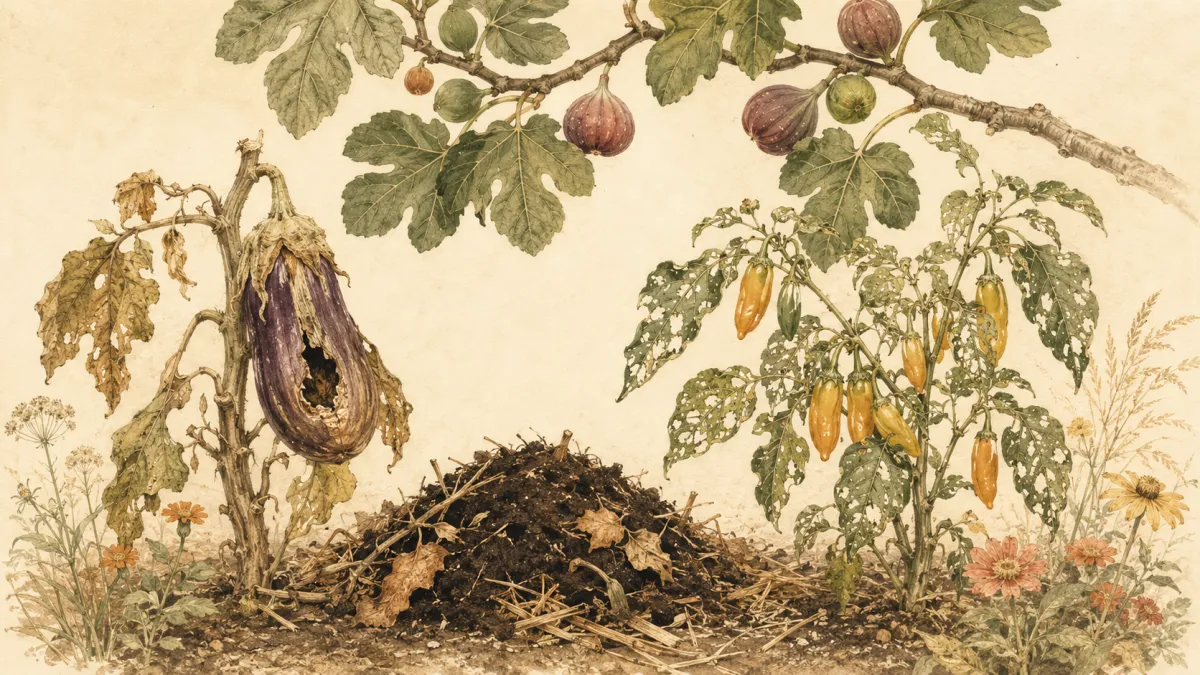
Every few mornings this month I've walked out to find one of my eggplants hollowed out. Not nibbled — emptied. Just a shell left hanging there like a little lantern with the light gone out of it.
The first time, I told myself it was a fluke. The second time, I got annoyed. By the fifth morning — standing out there in my pajamas with the dew soaking through my slippers — what I felt was closer to grief. Which is a strange thing to feel over an eggplant, I know. But garden long enough and you know exactly what I mean.
And here's the part that gets me: I have never seen what's doing it. Maybe a rat. Maybe a bird. Something bold that comes in the dark and is gone before the sun is up. I water those plants. I've fussed over them. And something I've never laid eyes on is undoing the whole thing overnight.
And then, three feet away, my peppers
These aren't just any peppers. They're the gypsy peppers — the Hungarian ones — the ones I grew up with.
This summer has thrown everything at them. The heat here doesn't come politely; it comes in waves, one week soaking, the next week baking. They've taken heavy insect damage; some of the leaves look like lace. And still. Still they keep setting fruit. Smaller than usual, yes. But golden, and when you bite into one, the flavor is all there. Nothing got lost.
My parents grew these in Romania — whole rows of them, that same color. My mother fried them in a little oil until the skins blistered and the whole house smelled like home. When I plant them here, in a Houston heat that has never once heard of a Carpathian summer, I'm not just growing a vegetable. I'm keeping a thread unbroken between that little girl in Romania and this woman standing in her suburban garden with gray coming into her hair.
Some plants are just plants. And some plants are a covenant with where you came from.
The fig tree that got one more year
In Luke 13, Jesus tells a story about a fig tree that hasn't borne fruit in three years. The owner is done: Cut it down. Why should it use up the soil?
But the gardener — I love this man — doesn't argue that the tree is fine. He doesn't pretend. He says: Sir, leave it alone for one more year. Let me dig around it and fertilize it. If it bears fruit next year, well and good; but if not, then cut it down.
One person is ready to cut it down. The other says: let me get down in the dirt around it. Hold both of those. We need them both.
Not everything in your life is meant to be saved — and letting it go is not the same as failing. When I finally pull those eggplants, they're not going in the trash. They're going in the compost. By October, the plant that's breaking my heart right now will be the dark, rich stuff feeding whatever I plant next. Nothing is wasted in a garden. The thing you release doesn't disappear — it becomes provision for a season you can't see yet.
We forget that. We hold on to things — a role we've quietly outgrown, a way we've always done the holidays, a friendship that's really just a shell we keep watering out of loyalty — long past the season, because letting go feels like defeat. And all the while we're pouring water and worry and midnight energy into something being hollowed out by something we can't even name.
Some things get the compost pile. And the compost pile is holy ground.
But some things get dug around, and fertilized, and given one more year. That's my peppers. I'm out there right now feeding them — fish emulsion, a little seaweed to help them stand up under the heat — digging around the roots, giving them every reason to keep going. Not because they're thriving. They're damaged. They're producing less than they should. I'm fighting for them because of what they are.
And I want to be honest about what that fight costs, because it isn't romantic. Digging around a struggling plant is dirty, repetitive, unglamorous work. It's showing up on the hot days with no visible reward, feeding something that still looks half-dead. Fighting for the right thing rarely feels heroic in the moment. Mostly it feels like kneeling in the dirt again for something the world would have written off. That's what real tending is.
Three practices for this week
1. Walk the beds and sort honestly. Go out early, before the heat. Look at each struggling plant and ask one question: is this being hollowed out, or is this damaged but still bearing? Damaged-but-bearing gets fed. Hollowed-out gets named. (If it's peppers you're nursing, here's my late-summer pepper troubleshooting guide.)
2. Feed the ones worth another year. Pick your two or three and actually dig around them — loosen the soil at the root line, water deep, feed them (fish emulsion and seaweed are my summer standbys). Do it on the hot day when it feels pointless. That's the whole practice.
3. Compost with honor, not shame. When you pull the hollowed-out plant, put it in the compost and say what it was. It fed you something. It's going to feed the fall bed. (New to it? Start with my tropical composting system for hot climates.) Letting go isn't throwing away.
The gentle question
It is not more faithful to save everything. And it is not more faithful to cut everything down at the first sign of trouble. The faithful thing — the hard, holy, grown-up thing — is to know the difference.
So this week, don't fix anything yet. Just go find the one thing you've been pouring yourself into out of fear, and the one thing you've been neglecting that's still quietly bearing fruit. Name the compost, and name the pepper. Sometimes seeing them clearly is the whole work.
And remember whose job the verdict is. I'm not the one standing over the vineyard with the ax — that's the Owner. I'm the gardener, down in the dirt, digging and feeding what's been entrusted to me, and trusting Him with the final call.
You don't have to have it figured out today. You just have to stop pouring your whole self into the hollowed-out thing while you starve the one that's still faithfully bearing fruit.
🎧 Listen to the full episode → 111 | The Plants Worth Fighting For
New this week inside the episode: True or Trowel, a quick garden true-or-false, and From the Garden Gate, where I answer one real listener question. Send me yours — it might be the one I read on air.
The free Rooted in Grace eBook is yours at rootedingrace.me — a gentle companion for meeting God in the ordinary garden of your life.
Ready to actually slow down? Rooted Reset is a five-day, mostly quiet email journey — $25 at rootedingrace.me.
Something to hold, or to give: the Rooted in Grace paperback and the 30-Day Rooted in Grace Devotional are both on Amazon — search "Rooted in Grace."
Come find me: Instagram @southernsoils · Pinterest @southernsoilsunshine · Facebook: Southern Soil Sunshine