Restore What the Locusts Have Eaten: Grief, Compost, and the Hope of a New Season
🎧 Listen to this episode → 121 | Restore What the Locusts Have Eaten
This week I stood over a compost bin — the place where I throw what's finished — and found brand-new life growing out of it.
I think that's the truest thing the garden has told me all summer.
What this season ate
Let me be honest about where my garden is, because it has been a season of loss and I don't want to skip over that part.
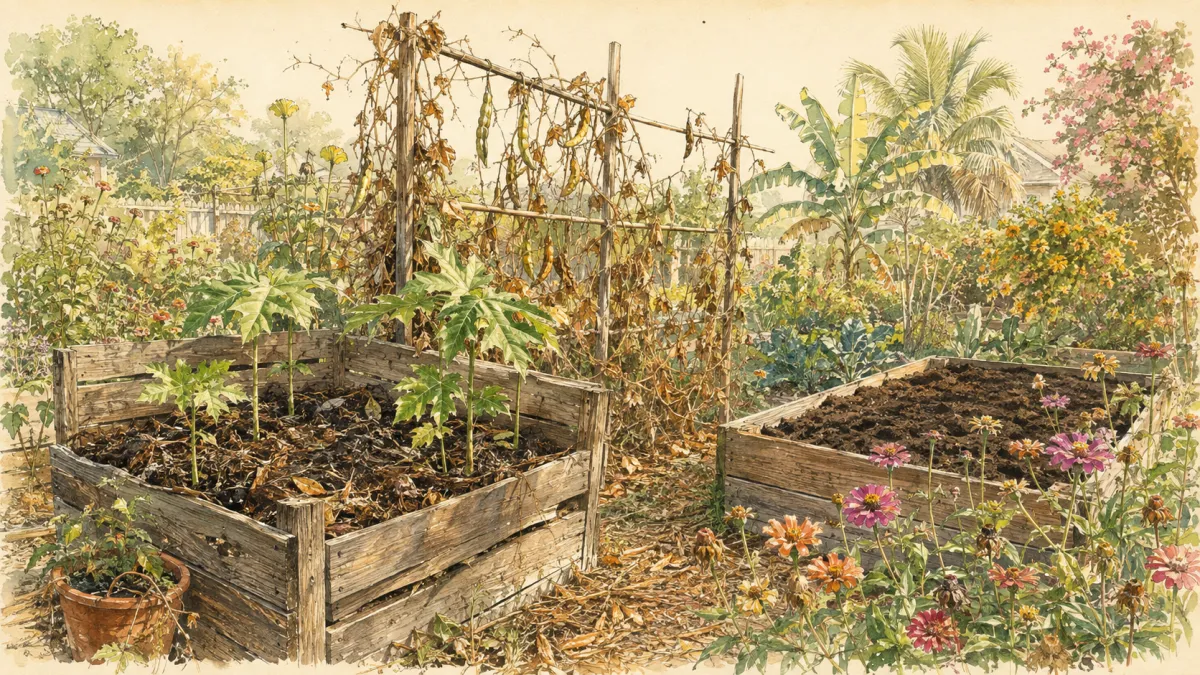
The heritage beans — the kind I grew up with, the ones that carry my whole childhood in them — got hit with blight in all this heat and humidity. I've pulled some of them already. My first okra plant, the big one I was so proud of a few weeks ago, I finally took out too. It was spent, half-eaten, taking up space and giving almost nothing back.
But there are more beans I still haven't gotten to, and I keep walking past them. It isn't that I'm busy, though I am. It's that pulling them makes it official. As long as they're out there, even brown and blighted, some part of me gets to pretend the season isn't over.
You've done this too, I think. Left the dead thing standing a little longer because taking it out means admitting it's really gone.
There are locusts that eat more than plants
This scorching season ate a lot from me. Time I meant to spend differently. Energy I never got back. Goals I set and didn't reach, plans that quietly got hollowed out while I was just trying to survive the heat.
If you've had a stretch like that — where you look back and it feels like something devoured the very thing you were working so hard for — then you know the field Joel is standing in.
"I will restore to you the years that the swarming locust has eaten… You shall eat in plenty and be satisfied, and praise the name of the Lord your God, who has dealt wondrously with you." — Joel 2:25–26
Not the days. The years.
And here's the real danger of a locust season: not the loss itself, but the story you start telling yourself about it. That you wasted the year. That the effort didn't count because the harvest didn't come.
Joel is careful with this. He calls the locusts God's great army — he refuses to let the people carry the devastation as personal failure. A swarm came through that you did not send and could not have stopped.
So the first true thing is simply this: name what the locusts ate. Don't rush past it. It's okay to grieve the beans. It's okay to grieve the year.
Then I looked in the compost bin
Here's what I found while I was out clearing the wreckage. In one of my compost bins — the place where I throw what's finished, what's done, what I've given up on — there is new life sprouting. Little volunteer papaya trees, tiny and green, rising straight up out of the stuff I discarded.
I didn't plant them. I didn't earn them. They grew out of what I threw away.
And once I had eyes for it, it was everywhere. The okra I planted later, after I'd stopped fussing, is in full life now. The cucumbers I put in during the heat of mid-July, the ones I nearly wrote off, are finally strong enough to flower. The zinnias I never replanted are reseeding themselves all over the yard and will bloom right up until frost.
I lost the beans. But I did not lose the garden. While I was grieving one bed, God was quietly restoring three others.
And notice when He did it — while I was distracted, discouraged, barely keeping up. Every bit of that restoration happened in the parts I had, in some way, let go of. I think that's on purpose. If I could engineer it, I'd take the credit and call it competence. But you cannot manufacture a volunteer papaya out of a compost bin. That is pure gift.
Don't stop at verse 25, either. Verse 26 is where the promise lands: plenty. Satisfied. Praise. Restoration in God's hands isn't a grudging refund for a bad season. It's abundance on the far side of it — the kind that turns a grieving woman into a grateful one.
You can't receive the new season with your hands full of the old one
Part of why I could finally see the new life is that I stopped pouring myself into what was already finished.
This whole stretch has been less about growing and more about triage — clearing, consolidating, emptying the compost bins into the raised beds to top off soil that sank all summer. The most faithful thing I can do right now isn't to plant more. It's to put what I already have where it will actually be tended.
Which has me looking hard at some long beds behind the house — beds I genuinely can't see from anywhere I spend my day. Because I can't see them, I never think of them. Because I never think of them, I neglect them. And then I feel guilty about them, which is its own quiet tax on my energy. So I'm asking a question I would once have found unthinkable: maybe I let those beds go, and move that soil to a bed I'll actually love.
I'm learning, completely against my own nature, to garden within my limits. I am an over-extender by design — I always want more beds, more crops, more everything, and I spent years believing more was the same thing as faithful.
It isn't. Less, tended well, is more than a lot, neglected. A thing that only drains you has quietly stopped being a blessing, no matter how good it looks.
Three faithful steps for the turn into fall
- Name your locusts, out loud or on paper. The real things this season ate — the time, the energy, the goals. Don't soften the list.
- Draw a line in the sand. Bring that list to God and ask Him plainly to restore what was eaten. A line in the sand isn't denial. It's a border: the locusts had this season; they don't get the next one.
- Clear one spent thing. In the garden, the house, or the calendar. Pull it, and let it become compost for what's coming.
And don't wait to feel hopeful before you take the first step. I did not feel hopeful when I started clearing those beds. I felt tired and a little defeated. But clearing was itself an act of hope — an unglamorous bet that there would be a next season worth making room for. The feeling caught up later, when I saw the papayas. You act your way into hope far more often than you feel your way into it.
A gentle question
What are you asking God to restore this fall — and what spent thing are you still holding that's keeping your hands too full to receive it?
Here in Zone 9, fall is the most fruitful season we have, and almost nobody plants it. I think that's true of the soul, too. Some of the richest growth of your life is waiting on the other side of a season that tried to eat you alive.
🎧 Listen to the full episode → 121 | Restore What the Locusts Have Eaten: Grief, Compost, and the Hope of a New Season
Go deeper — Rooted Reset is a five-day, mostly-by-email journey for the woman standing in a stripped field, ready to clear the bed and hope again. $25.
Resources: the free Rooted in Grace eBook · the Rooted in Grace paperback and 30-Day Devotional on Amazon · @southernsoils on Instagram · Pinterest · Facebook · garden how-tos at southernsoilsunshine.com